If you want more customers from Google, you have two options: earn your place in the organic results with SEO, or pay for a place at the top with PPC (pay-per-click) ads. Both work. They just work differently — and choosing the wrong one for your situation is one of the most expensive mistakes in digital marketing.
Short answer: use PPC when you need leads quickly, want to test an offer, or are entering a new market. Invest in SEO when you want a lasting, lower-cost source of traffic and trust. Most growing businesses get the best results by running both — PPC for speed while SEO builds momentum.
What is SEO?
Search engine optimization is the work of making your website the best answer for the searches your customers make, so it ranks in the free (organic) results. It covers three areas:
- Technical SEO — site speed, crawlability, mobile experience, structured data.
- On-page SEO and content — pages and articles that match search intent and answer questions properly.
- Authority — reviews, mentions and links from other reputable websites.
You do not pay per click, but you do invest time and expertise, and results build over months.
What is PPC?
Pay-per-click advertising — most commonly Google Ads, plus Microsoft Ads, Meta, LinkedIn and others — lets you bid to appear at the top of search results or in social feeds. You pay each time someone clicks. Traffic starts as soon as campaigns go live, and stops as soon as you stop paying.
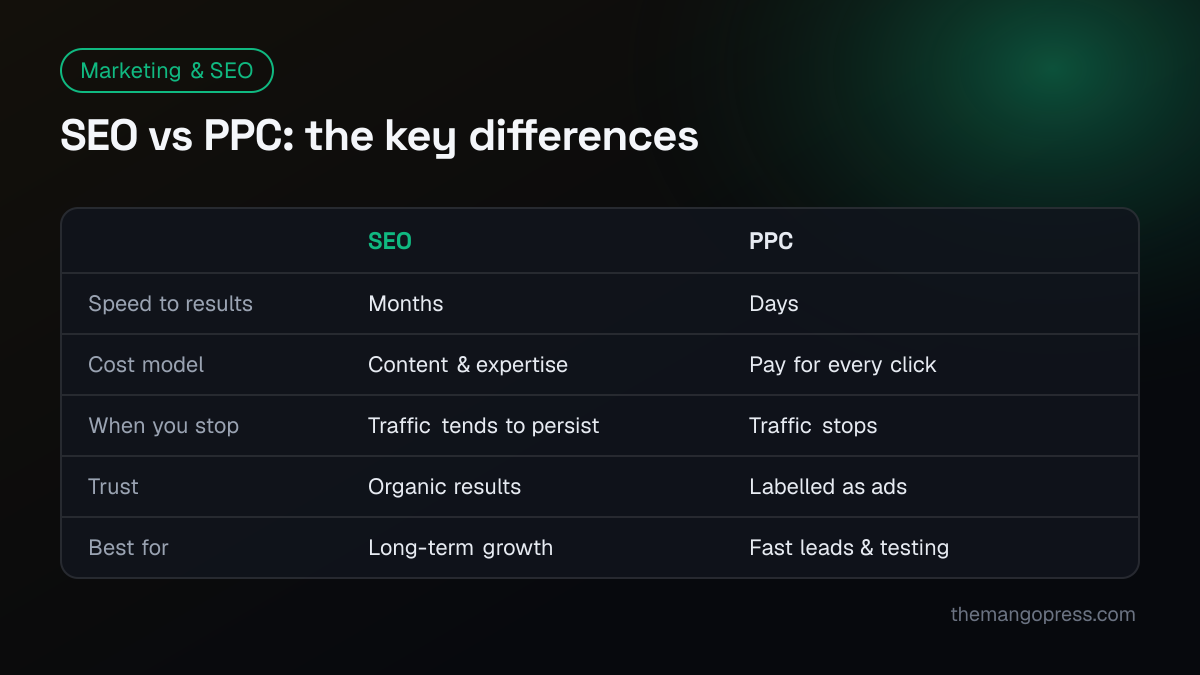
SEO vs PPC at a glance
| SEO | PPC | |
|---|---|---|
| Speed to results | Slow — typically months | Fast — days |
| Cost model | Ongoing investment in content and expertise; no cost per click | Pay for every click, plus management |
| When you stop | Rankings and traffic tend to persist for a while | Traffic stops immediately |
| Trust | Many users trust organic results more | Clearly labelled as ads |
| Targeting control | Limited — you influence, Google decides | Precise — keywords, location, device, audience, schedule |
| Testing | Slow feedback loop | Ideal for testing offers and messaging fast |
| Long-term ROI | Usually improves over time as content compounds | Stays roughly tied to ad spend |
When PPC should come first
- You need leads this month. A launch, a slow quarter or a new service with no rankings yet.
- You are testing an offer. PPC tells you within weeks which headlines, prices and landing pages convert.
- You are entering a new country. Running ads in the UK, UAE or Saudi Arabia is the fastest way to learn what converts before investing in local SEO.
- Your keywords are seasonal or time-sensitive. Events, promotions and short campaigns.
- Your organic competition is extremely strong. PPC can buy visibility while you build authority.
When SEO should come first
- You have a long-term horizon. SEO is an asset that keeps working.
- Your customers research before buying. Guides, comparisons and FAQs reach them early.
- Clicks in your industry are expensive. In competitive sectors, every organic visitor saves real ad spend.
- Trust matters. Ranking organically signals credibility — especially for B2B and professional services.
- You want to appear in AI answers. Tools like ChatGPT, Perplexity and Google AI Overviews draw on well-structured, authoritative content.
Why the best answer is usually "both"
SEO and PPC make each other better:
- PPC data guides SEO. Search-term reports reveal which keywords actually convert — so you write content for those first.
- SEO lowers PPC costs. Strong landing pages improve your Quality Score, which can reduce your cost per click.
- More real estate. Showing in both the ads and the organic results increases clicks and brand recall.
- Remarketing. Visitors who arrive through organic content can be retargeted with ads later.
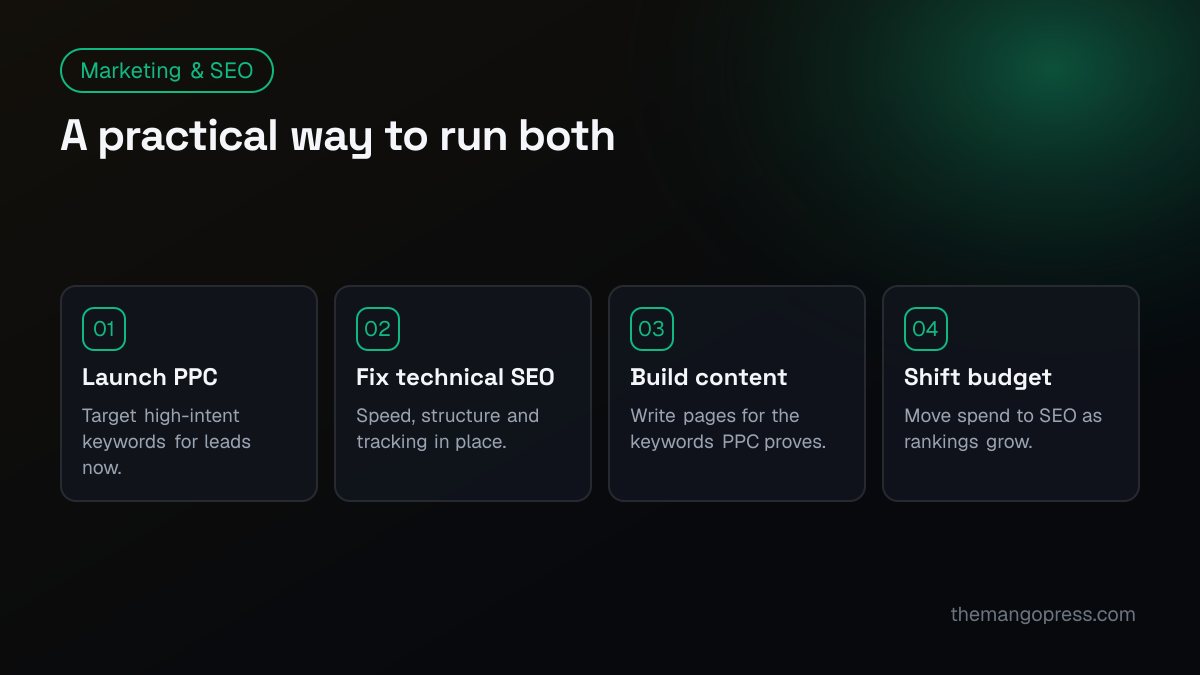
A practical split for many businesses is to lead with PPC for the first few months while technical SEO and core content are built, then shift budget toward SEO as organic rankings grow.
A simple framework to decide
Ask yourself three questions:
- How soon do I need results? Within weeks → start with PPC.
- What can I invest each month, and for how long? Small budget with patience → SEO. Budget for fast testing → PPC.
- How competitive is my market? Check who ranks and who is bidding for your top keywords.
If the answers point both ways, run a lean PPC campaign on your highest-intent keywords and start SEO in parallel.
Common mistakes to avoid
- Sending ads to your homepage instead of a focused landing page.
- Expecting SEO results in weeks and giving up just before it starts working.
- Ignoring tracking. Without conversion tracking in GA4 and your ad platforms, you cannot compare channels honestly.
- Treating them as separate teams. Messaging, keywords and landing pages should be shared.
Frequently asked questions
Is SEO cheaper than PPC?
Over the long run, often yes — because you are not paying for every click. But SEO requires steady investment in content and expertise before it pays back, so it is not "free traffic".
How long does SEO take to work?
Technical fixes can lift visibility within weeks, but meaningful organic growth usually builds over three to six months, and longer in very competitive markets.
Can PPC hurt my SEO?
No. Paid ads do not directly affect organic rankings. Used well, PPC data actually makes your SEO smarter.
Should a small business do SEO or PPC?
If you need customers now, start with a small, tightly targeted PPC campaign. At the same time, fix your website's technical SEO and build a few strong service pages so organic traffic grows underneath.
Not sure where your budget should go? Our digital marketing & SEO team plans SEO, paid media and social as one strategy — see how we helped Leap Networks UK become easier to find. Thinking about a new site first? Read how much a website costs, or get in touch for a free review of your current marketing.