The honest answer is that a business website can cost anywhere from a few hundred dollars to six figures. That range is useless on its own, so this guide breaks it down: what drives the price, typical ranges by website type, the running costs people forget, and how to get a quote you can actually trust.
Short answer: for most small and mid-sized businesses, a professionally designed and built marketing website sits in the low-to-mid four figures (USD), an e-commerce store in the mid four to low five figures, and a custom web application from the mid five figures upward. Where you land depends mostly on scope, content and who builds it.
What actually drives the cost of a website
Two websites can look similar and cost very different amounts. These are the factors that move the number:
- Number of unique page designs. Ten pages that share two layouts cost far less than ten pages that are each designed from scratch.
- Custom design vs. a template. A template gets you live quickly; a custom design is built around your brand and conversion goals.
- Functionality. Booking systems, member areas, calculators, multi-language support, payment gateways and CRM integrations all add build and testing time.
- Content. Copywriting, photography, video and product data are often the most underestimated part of a website project.
- E-commerce complexity. Product count, variants, shipping rules, taxes and payment providers all add work.
- SEO and performance. A site built to load fast and rank well — structured data, Core Web Vitals, technical SEO — takes more care than one that just "looks done".
- Who builds it. A DIY builder, a freelancer, an agency and an in-house team all price very differently.
Website cost by type
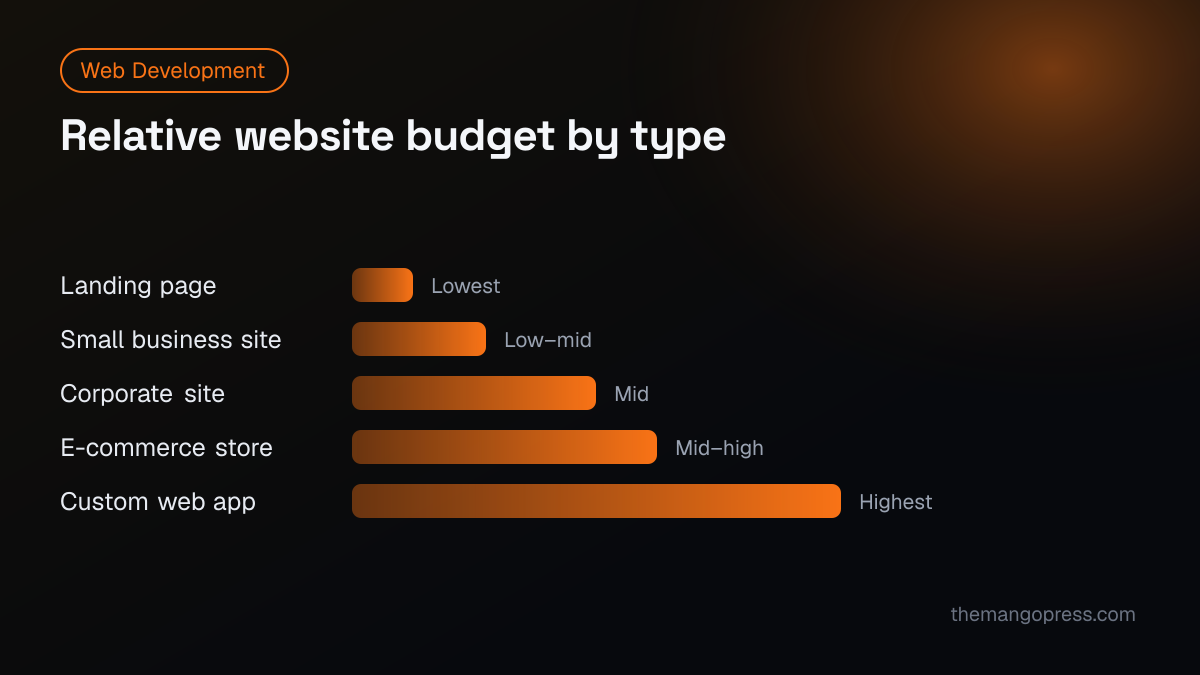
These are broad, indicative ranges for professionally built websites. Your quote will depend on the factors above and on the market you hire in.
| Website type | What it is | Indicative budget (USD) | Typical timeline |
|---|---|---|---|
| Landing page | One focused page for a campaign or product launch | Low hundreds to low thousands | 1–2 weeks |
| Small business website | 5–10 pages, contact forms, basic SEO | Low to mid thousands | 3–6 weeks |
| Corporate / marketing website | 15+ pages, custom design, CMS, integrations | Mid thousands to low tens of thousands | 6–10 weeks |
| E-commerce store | Product catalogue, cart, checkout, payments | Mid thousands to tens of thousands | 6–12 weeks |
| Custom web app or portal | Logins, dashboards, business logic, APIs | Tens of thousands and up | 2–6 months |
If a quote is far below these ranges, ask what has been left out. If it is far above, ask what you are getting that justifies it.
DIY builder vs. freelancer vs. agency
| Option | Best for | Watch out for |
|---|---|---|
| DIY (Wix, Squarespace) | Very early-stage businesses testing an idea | Your time cost, generic design, limits on SEO and speed |
| Freelancer | Smaller, well-defined projects with a clear brief | Single point of failure, gaps between design, build and marketing |
| Agency | Businesses that need strategy, design, development and SEO working together | Higher upfront cost — check that senior people actually work on your project |
The real question is not "what is cheapest" but "what will this website return?" A site that generates a handful of extra qualified leads a month usually pays for itself quickly.
The ongoing costs people forget
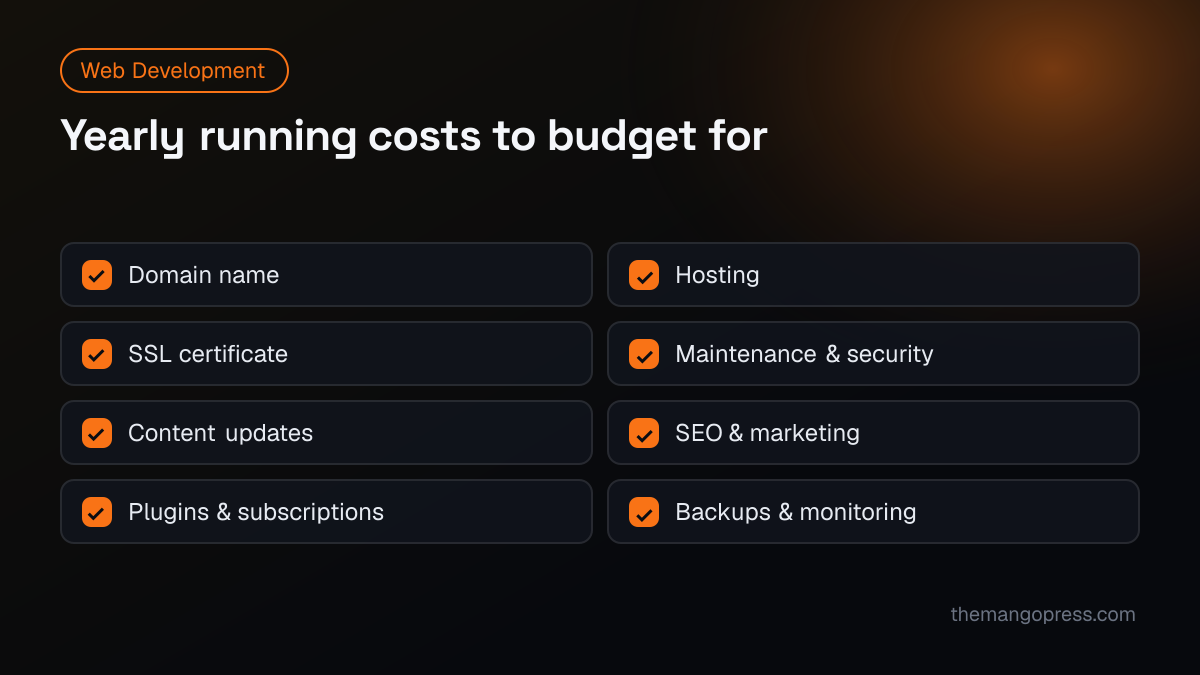
The build is only part of the cost. Budget for these every year:
- Domain name — usually a small annual fee.
- Hosting — from very cheap shared hosting to managed cloud hosting for busy or e-commerce sites.
- SSL certificate — often free now, but confirm it is included.
- Maintenance and security updates — essential for WordPress and plugin-based sites.
- Content updates — new pages, case studies and blog posts keep the site useful and ranking.
- SEO and marketing — a website without traffic is a brochure in a drawer.
- Third-party subscriptions — premium plugins, booking tools, email marketing, Shopify apps.
How to save money without cutting corners
- Write a clear brief. List your goals, must-have pages and features, and three sites you like.
- Prepare your content early. Delayed copy and images are the most common reason projects overrun.
- Launch in phases. Ship the core site first, then add advanced features once real visitors show you what they need.
- Use a proven platform. Not everything needs to be custom — pick the right tool for the job.
- Build SEO in from day one. Retrofitting SEO after launch costs more than doing it right the first time.
How to get an accurate website quote
When you contact an agency or freelancer, include:
- What the website must achieve (leads, sales, bookings, credibility).
- A rough list of pages and features.
- Whether you have brand guidelines, copy and photography.
- Integrations you need (CRM, payments, booking, email).
- Your target launch date and budget range.
A good partner will ask follow-up questions, explain trade-offs and give you a written scope — not just a number.
Frequently asked questions
Is a cheap website a bad idea?
Not always. A simple, well-built site is far better than no site. The risk with very cheap websites is slow performance, poor SEO and designs that do not convert — problems that cost more to fix later.
How long does it take to build a website?
Most small business websites take 3–6 weeks. Larger marketing sites and e-commerce stores usually take 6–12 weeks, and custom web apps longer. Content readiness is the biggest variable.
Should I pay monthly or upfront?
Project builds are usually paid in milestones (for example, a deposit, then on design approval and launch). Ongoing maintenance, hosting and SEO are typically monthly.
Does the price include SEO?
It should include technical SEO basics — clean code, metadata, sitemaps, fast load times. Ongoing SEO (content, links, rankings) is a separate service. Read our guide on SEO vs PPC to see how they fit together.
Want a clear quote for your website? We design and build fast, SEO-ready websites and online stores for businesses worldwide — see our web development services or examples like the ZK Closet e-commerce store and Leap Networks Arabia redesign. Then tell us about your project and we will send a transparent, fixed-scope proposal.